
- Keep an antenna or mast at least 1 1/2 times its height away from power lines.
- Ground every mast in line with electrical codes.
- Pick a calm, dry day for any roof work.
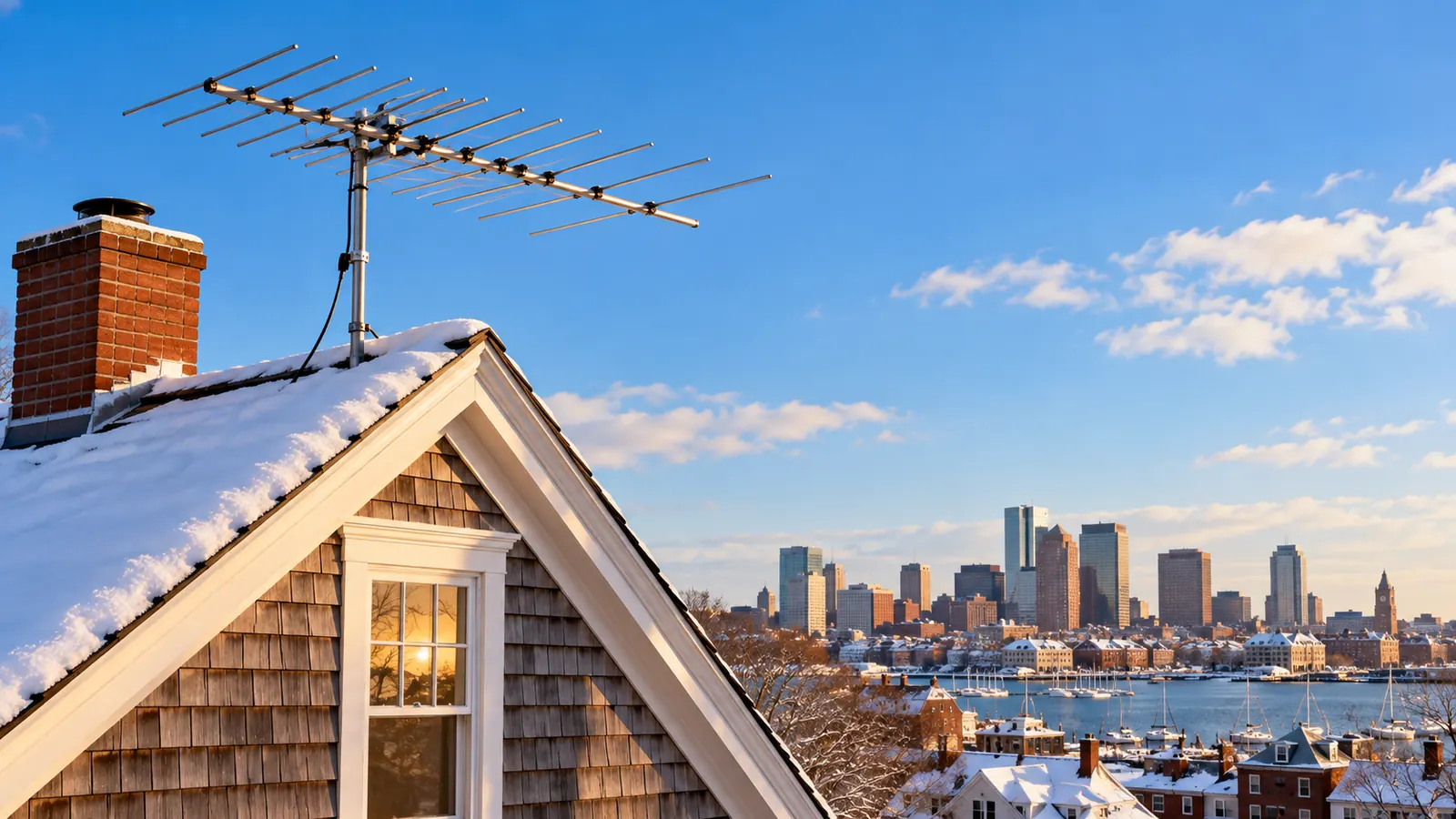
A rooftop antenna is the strongest way to receive free TV in the hills and outer suburbs around Boston. It is also the only option on this site that can hurt you. Before thinking about channels, think about the roof, the power lines near it and the weather it has to survive.
Power lines first
The Consumer Product Safety Commission has warned for decades about electrocutions when antennas or ladders touch overhead power lines. In a 2002 release it noted that antenna electrocutions had fallen from 186 a year in the mid-1970s to about 20 a year in the 1990s after safety standards were introduced, and it warned that people taking down older antennas were at risk again.
The CPSC’s precautions are worth following to the letter:
- Keep masts, poles, ladders and tools far away from power lines at all times.
- Keep the distance from an antenna or pole to a power line at least 1 1/2 times the height of the antenna or pole.
- Never assume an overhead line is insulated; treat any contact as potentially lethal.
- When taking down or moving an old antenna, look for power lines added since it was installed.
- Use a non-metal ladder and position it so neither you nor the ladder can reach a line.
- Stay away from downed lines; current can travel through the ground.
Tip: If the only good spot for an antenna is anywhere near the service drop to your house, hire a licensed installer. That is not a job to learn on.
Grounding
The CPSC also says to properly ground all masts in accordance with electrical codes. Grounding gives static and stray current a safe path to earth instead of through your TV or wiring. Local electrical codes set the details, so if you are not sure how your house is grounded, ask an electrician to check the job.
Wind, snow and ice
New England roofs carry snow loads, ice and nor’easter winds. A mast that wobbles in the first storm will loosen its mounts, loosen your shingles and eventually drift off its aim. A few habits help:
- Use a mount rated for the antenna’s size and weight, and fix it to framing, not just roof boards.
- Keep the antenna as low as reception allows; height adds leverage for the wind.
- Seal every roof penetration and check it each spring.
- Inspect the mount and cable after major storms, from the ground with binoculars first.
Pick a calm, dry day for any work up there, and never go up on an icy or wet roof.
Where you are allowed to mount it
The FCC’s antenna rule, 47 CFR 1.4000, protects your right to install a TV antenna on property in your exclusive use or control, and it covers the mast that supports it. It does not give you rights over common areas such as a shared roof in a condo building. Restrictions may still apply for clearly defined safety reasons or to protect a historic property, as The Best TV Antenna for Boston: How to Choose One for Your Home explains.
If you do go up, plan the cable route as carefully as the mount. Bring the cable down and into the house in a way that sheds water, leave a small drip loop before it enters, and seal the entry point. A neat run is easier to inspect after storms and less likely to work loose in the wind.
Is the attic good enough?
Often, yes. An attic antenna avoids the weather and the roof work entirely. It loses some signal through the roof, and foil-faced insulation or a metal roof can block it badly, so scan with the antenna in the attic before you commit to the roof.
Taking an old antenna down
Many New England houses still have an old antenna on the chimney or roof from decades ago. The CPSC specifically warned about this situation: people removing older antennas, which may be uninsulated and may now sit near power lines added since they were installed. Treat removal with the same care as installation, and if a line is anywhere near, leave the job to a professional.
Check the chimney or roof where the old mount was attached once it is gone. Old bolt holes and straps are a common source of leaks, and it is easier to seal them while the ladder is already up.
After the install
Aim the antenna, run a full scan and write down the stations you receive. If a storm later knocks stations out, compare against that list. Several missing at once points to the antenna or cable; one missing usually means the station moved or changed something, and a rescan fixes it. For FM radio on the same mast, see Better FM and AM Reception in Boston: Practical Fixes for Weak Stations.