
- Boston stations use both VHF and UHF RF channels, so choose an antenna that receives both.
- Federal rules limit how landlords and associations can restrict antennas in areas you control.
- Rescan every time you move the antenna.
Key takeaways
- There is no single best antenna; the right one depends on your distance, your building and the channels you want.
- Several Boston stations broadcast on low RF channels, so pick an antenna rated for VHF as well as UHF.
- Try a simple indoor antenna in a window first, then move up to attic or roof only if you need to.
- The FCC’s OTARD rule protects your right to install a TV antenna on property you control.
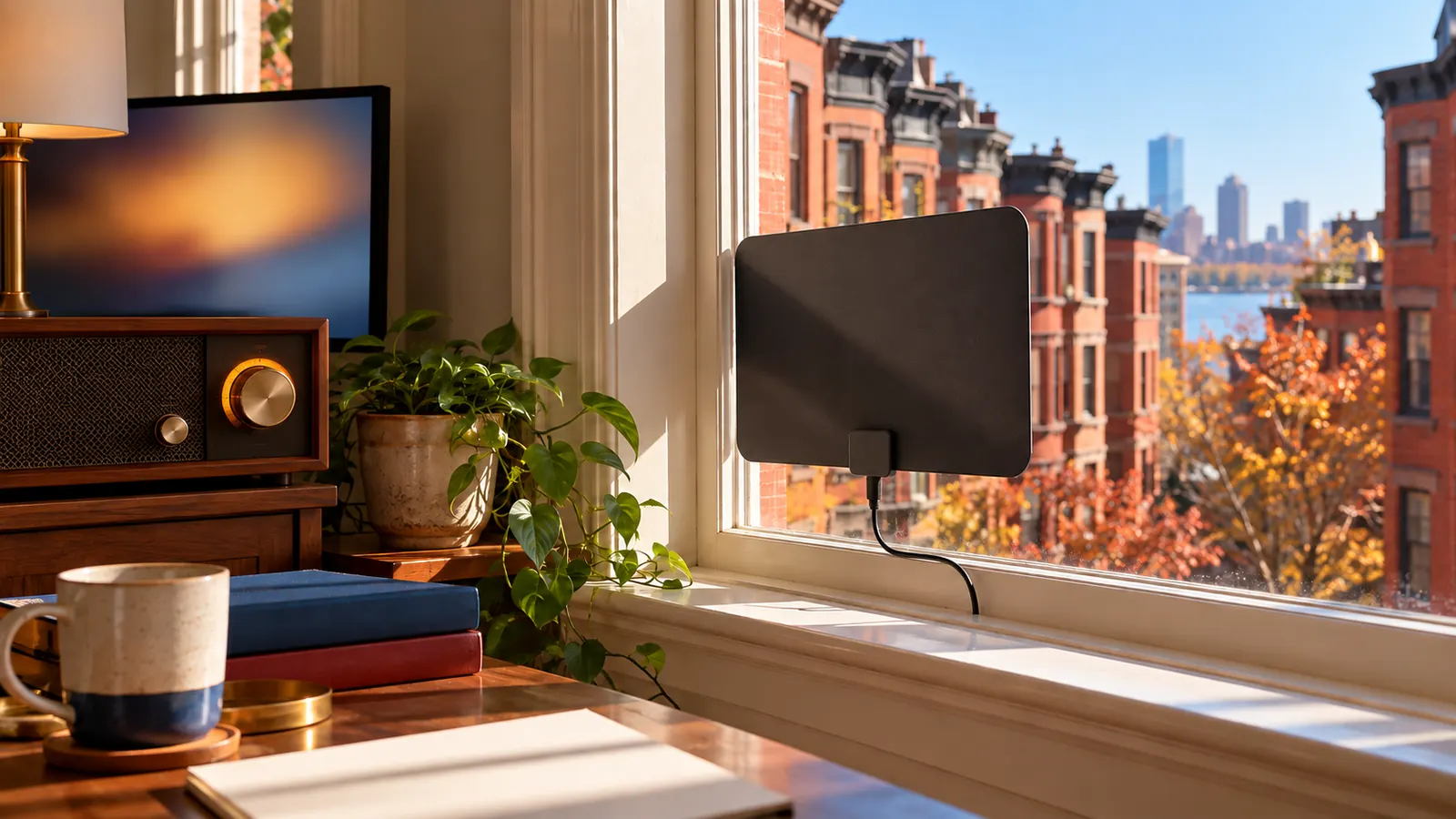
Free over-the-air TV in Boston is good enough that many households never pay for a channel package again. The catch is that antennas are sold with bold claims about range and channel counts that do not tell you much about your own living room. This guide works backwards: start with the stations you want, then pick the antenna.
Step 1: Look at the RF channels, not the channel numbers
The number your TV shows is a virtual channel. What matters to the antenna is the RF channel the station really transmits on. In Boston that range is wide. According to the FCC’s public files, GBH 2 transmits on RF channel 5 and WMFP on RF channel 10, which are VHF channels, while most others, such as WBZ-TV on 20, WCVB-TV on 33 and WFXT on 34, are UHF. Our Boston TV Channels: Every Local Station You Can Get With an Antenna has the full table.
Many flat indoor antennas are designed mainly for UHF. If GBH 2 matters to you, check that the antenna you buy is rated for VHF as well. GBH itself tells viewers to make sure they have a VHF/UHF antenna connected before scanning.
Step 2: Choose a type
| Type | Best for | Trade-offs |
|---|---|---|
| Flat indoor | Apartments and homes close to the transmitters | Easy to hide; weaker on VHF and behind brick or foil-backed insulation |
| Indoor with amplifier | Long cable runs or several TVs | An amplifier boosts noise too and can overload a receiver near strong stations |
| Attic | Houses where the roof is off-limits or the weather is a worry | Roofing materials and wiring reduce signal; still out of the weather |
| Outdoor or rooftop | Distant suburbs and hilly areas | Best signal, most work; read Rooftop TV Antennas in New England Weather: Safety, Grounding and Storms first |
Step 3: Placement matters more than price
- Put an indoor antenna in a window, as high as you can.
- Keep it away from metal: radiators, foil-backed blinds, appliances.
- Try two or three spots, rescanning each time, and keep the one that finds the most stations.
- On a brick or stone building, a window facing the city usually beats an interior wall.
Tip: Run a scan after every move. A TV keeps its old channel list until you scan again, so an antenna can look worse than it is.
Before you buy, list the five or six stations you watch most and check their RF channels in the table on our channel list. If they are all UHF, almost any indoor antenna will do. If one of them is VHF, read the box carefully and choose a model that clearly says it receives VHF, because that single station is often the one people lose.
Your right to put up an antenna
Renters and condo owners are often told antennas are not allowed. Federal law says otherwise in many cases. The FCC’s Over-the-Air Reception Devices rule, at 47 CFR 1.4000, prohibits restrictions by local governments, landlords and homeowners associations that impair the installation, maintenance or use of an antenna used to receive television broadcast signals, on property within your exclusive use or control where you have an ownership or leasehold interest. A restriction impairs reception if it unreasonably delays or prevents installation, unreasonably increases the cost, or keeps you from getting an acceptable signal.
There are limits. The rule covers areas you control, such as your own balcony or patio, not shared roofs or common walls. Restrictions are still allowed when they are necessary for a clearly defined safety objective, or to preserve a property on or eligible for the National Register of Historic Places, as long as they are no more burdensome than necessary. In older Boston neighborhoods the historic-preservation exception can matter, so ask before you drill.
One antenna, several TVs
If you want antenna TV in more than one room, you can split one antenna’s signal, but every split weakens it. A good antenna in the best location, feeding a splitter, usually beats several weak indoor antennas. If the picture breaks up after you add a splitter, that is when a distribution amplifier earns its place.
When nothing works
If a scan finds very little even after several placements, the problem may be the building rather than the antenna. Large steel and concrete buildings, hills and low basements all block signals. In that case an attic or outdoor antenna, or a different room on a higher floor, usually helps more than a more expensive indoor model. And if you only want local news, How to Watch Boston Local News Without Cable covers the free streams most stations offer.